
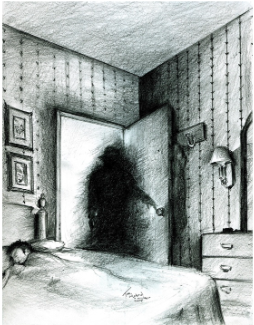
You awaken to a low-frequency, static-like humming in your ears, your eyes greeted by the indescribable darkness of your inner eyelids. A feeling of impending doom begins to compound with each breath, paralyzing every muscle fiber and consuming every thought. Your inner awareness debates a frightening conclusion you can’t help but believe: Someone is watching me… something is watching me. Primal curiosity slowly pulls your eyelids apart, your vision struggling to focus in the dark room you fell asleep in a few hours earlier. Then you see it. The outline of a tall person in your doorway, perfectly delineated against the dim light of the adjacent room. You open your mouth to scream, but it’s as if the air in your lungs has abandoned you in your time of need. With each blink, the figure gets closer. And closer. Until… Until you fully wake up. The scenario above describes a terrifying but real phenomenon known as sleep paralysis. Sleep paralysis is a rapid-eye movement (REM) parasomnia in which an individual maintains a state of conscious awareness with absent voluntary muscle control1. Essentially, the body’s awakening from REM sleep precedes termination of REM-mediated atonia, the physiological inhibition of skeletal muscle during REM sleep. Episodes typically involve a feeling of intense fear in addition to auditory, tactile, and/or visual hallucinations. Sleep paralysis has been divided into three factors depending on the experience: intruder presence, incubus-induced chest pressure, and vestibular-motor out-of-body experiences2. A large-scale epidemiologic study estimated the prevalence of sleep paralysis in the general population to be 7.6%, with prevalence in students and psychiatric patients being 28.3% and 31.9%, respectively3. Hypertension, obstructive sleep apnea, narcolepsy, and alcohol use are among risk factors that predispose patients to this skin-crawling experience4. While the event feels as if it is based in reality, researchers have identified key neural circuitry responsible for conjuring such horror. During REM sleep, neurons in the ventromedial medulla release inhibitory neurotransmitters, gamma-aminobutyric acid (GABA) and glycine, that hyperpolarize neurons in the spinal cord1. Such inhibition results in muscle atonia, preventing an individual from acting out their dreams. In a wakeful state, cortical arousal is promoted by the neuropeptide orexin through its stimulation of noradrenergic, cholinergic, histaminergic, and serotonergic neurons1. During sleep paralysis, these paradoxical pathways collide. Altered signaling of serotonin 2A receptors has been associated with hallucination manifestation, sometimes dissociative, during sleep paralysis1. Interestingly, visual hallucinations seen in Parkinson’s disease are associated with increased serotonin 2A receptor density in the inferolateral temporal cortex, suggesting a potential role for this receptor type in sleep paralysis’ hallucinatory effects1,5. Amygdala activation produces a feeling of danger or threat during the phenomenon, further intensifying the experience2. The concurrence of inhibitory and arousal signaling effectively explains, in part, how sleep paralysis manifests. Or does it? While research findings can explain how sleep paralysis occurs, different cultures around the world have sought to explain why. In Egypt, it’s believed that sleep paralysis is the devious work of a spiritual creature known as a Jinn2. Japanese interpretation regards sleep paralysis as a visit from the Kanashibari, a demon that tries to suffocate the onlooker2. From the blood-sucking Karabasan in Turkish folklore to the Newfoundland’s Old Hag who sits on and crushes the chest of its victim, shared regional interpretations of sleep paralysis have highlighted the influence of cultural beliefs and values on one’s understanding of the experience2.
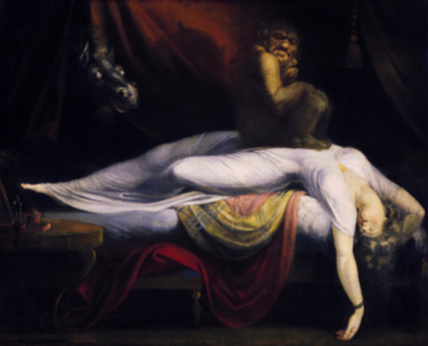 Figure 1. The Nightmare (1781) by Henry Fuseli, depicting the incubus and chest-pressure experience historically associated with sleep paralysis. Public domain.
Researchers sought to examine the effect of cultural influence on sleep paralysis severity and prevalence. Subjects in Denmark, a region with fewer cultural associations with sleep paralysis, had lower rates of sleep paralysis and decreased time of immobility compared to the findings from Egyptian students, whose aforementioned cultural interpretations of sleep paralysis frequently involved Jinn-related beliefs5. Yet despite cultural differences, many reported experiences share remarkably similar features. Perhaps the remarkable consistency of these stories reflects a universal attempt to explain an experience that feels far too real to be a dream. Whether you believe sleep paralysis can be explained by physiological asynchrony or something more sinister, the experience remains utterly petrifying. The next time you wake up unable to move, think twice before opening your eyes. You might not like what you see. Resources
- https://psychiatryonline.org/doi/10.1176/appi.ajp-rj.2023.180401
- https://pmc.ncbi.nlm.nih.gov/articles/PMC6082011/
- https://pmc.ncbi.nlm.nih.gov/articles/PMC3156892/
- https://pmc.ncbi.nlm.nih.gov/articles/PMC11344621/
- https://pubmed.ncbi.nlm.nih.gov/20629135/
-
https://www.psychologytoday.com/us/blog/non-weird-science/202501/how-does-sleep-paralysis-differ-around-the-world
- Cover Image credit: Tim Madred (Timitzer), Shadowman-3, CC BY 3.0, via Wikimedia Commons.